

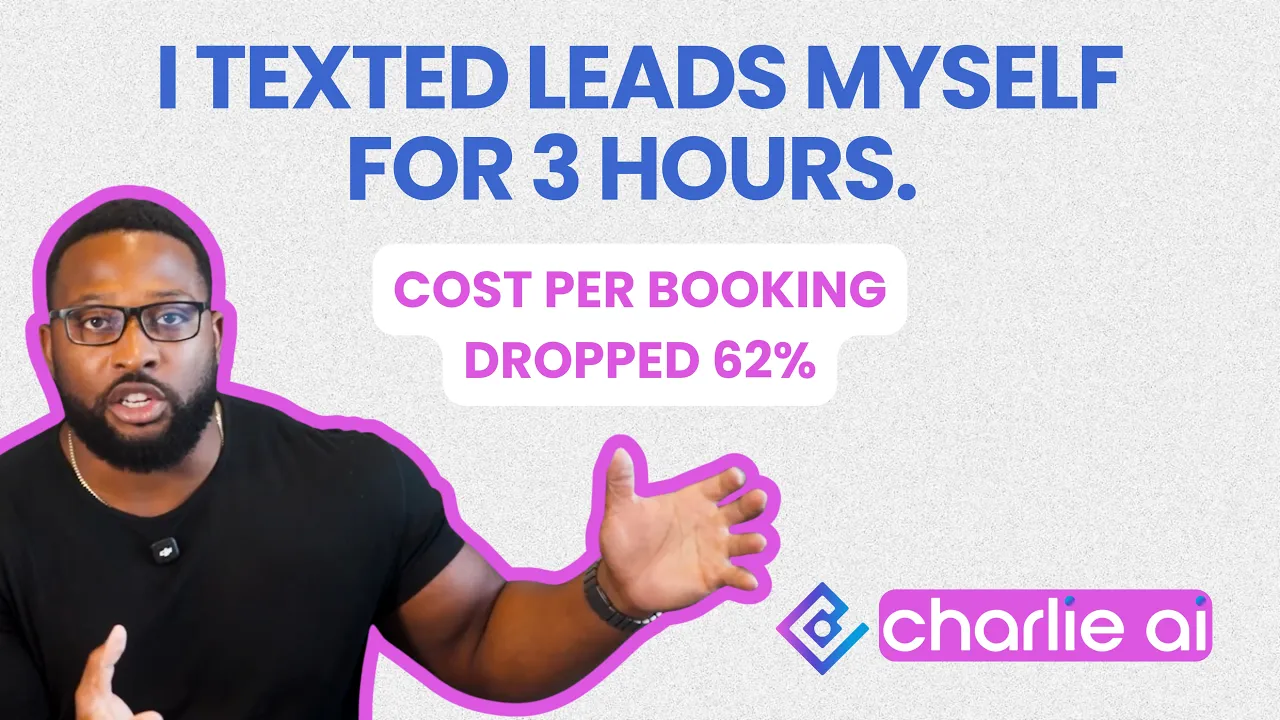
I spent three hours personally texting leads, and our cost per booking dropped 62%.
These weren't cold leads. They'd gone through the funnel, qualified, and been asked to book. Then they went quiet.
Our AI kept following up, trying to get the conversation going again. But bookings weren't keeping up with our ad spend. So I exported the list, started texting, and focused on one thing: getting a time on the calendar.
People started replying. "Tomorrow at 11 works." I booked them as the replies came in.
That's one account, and it doesn't mean every business will see the same result. But it changed how we built booking follow-up inside CharlieAI.
We were spending more on ads, and cost per booking kept climbing. When I looked at where people were dropping off, I kept seeing the same thing. They made it through qualification. They got to the booking step. Then nothing.
When a lead stops replying, the natural instinct is to restart the conversation. We were sending versions of these too:
"Still interested?" This asks them to reconsider the offer.
"Any questions I can answer?" This asks them to figure out what they need to know.
"Just checking in." This doesn't give them much to respond to at all.
These people had already engaged and answered our questions. I started wondering whether our follow-up was making the next step harder than it needed to be.
I pulled the list of qualified leads who had stalled before booking and texted them myself:
"Are you free today or tomorrow for a quick call?"
It's a small question with an easy decision. They could tell me which day worked, suggest a time, or say they weren't available.
When someone replied, I stayed focused on scheduling:
If they said tomorrow, we worked out a time tomorrow.
If they gave me a time, I booked it.
I didn't send them back through questions they'd already answered.
Over those three hours, cost per booking dropped 62%. These leads were responding when we made the next action clear and easy.
We took that behavior and built it into Charlie as auto-booking hunts. The job is simple: help a lead choose a time.
If someone has been offered availability and goes quiet, Charlie follows up with fresh available slots, and the follow-up stays focused on scheduling.
Someone on my team pushed back: "Don't we already have CTA hunts?" We do. But those are built to get a response and bring someone back into the conversation. This handles a more specific moment. The lead has already reached scheduling, and the goal is to finish that step.
Think about the difference between "Hey, are you still interested in learning more?" and "Would today or tomorrow work for a quick call?" The first opens up a broad decision. The second gives someone a clear next move. If a lead has a question or an objection, that still matters. But not every silent lead needs the whole conversation restarted.
The experiment led to three more changes inside Charlie:
Qualified application leads move to booking. For application leads whose answers already meet the qualification criteria, Charlie can move them straight to booking after the third unanswered intro follow-up. Filling out an application alone doesn't mean someone should get booked. But if they're a fit, we shouldn't keep making them repeat that work.
Same-day bookings skip the confirmation request. If someone just booked a call for later today, asking them to confirm again adds a step they don't need. They still get reminders.
"Yes" isn't a booking. We found cases where Charlie could take a "yes" as permission to book without an agreed time. "Yes, I'm interested" and "yes, tomorrow at 11 works" mean different things. Charlie now requires an explicit time slot before it creates a booking.
A calendar full of appointments doesn't help if people never agreed to them. We want bookings that reflect a real commitment.
After we built the scheduling behavior into Charlie and turned it on in that account, cost per booking stayed below $200 every day from the following Monday through the period we tracked. We hadn't reached that level in four months.
Here's my takeaway. We were putting a lot of effort into getting leads back into a conversation. But for this group, the conversation had already done its job. They were qualified and had reached scheduling. The follow-up needed to help them finish.
That's easy to miss when you look at your funnel as one big conversion number. Costs rise, and you start thinking about new creative, new audiences, or a new offer. Sometimes you need those changes. But look at the handoff right before the booking too.
Pick a group of leads and work through these steps:
Find the qualified leads who were asked to book and stopped responding.
Read the last few messages they received. Are you helping them choose a time, or asking them to start the decision over?
Try a straightforward scheduling question, like "Are you free today or tomorrow for a quick call?"
When they respond, help them pick an available time.
Track replies, bookings, and whether those people actually show up.
That will tell you a lot more than another round of "just checking in."
In the full Founder Fires episode, I walk through the experiment, what we changed inside Charlie, and how to spot this gap in your own pipeline.
For a framework to find where leads stall across your pipeline, check out the AI Lead Management Playbook.
Want to see how CharlieAI gets qualified leads onto the calendar? Bring your booking numbers, and we'll look at where people are getting stuck.
Experience It
Share your number and Charlie will text you to start a conversation. You can ask questions, explore features, or even request a call directly with the AI.