

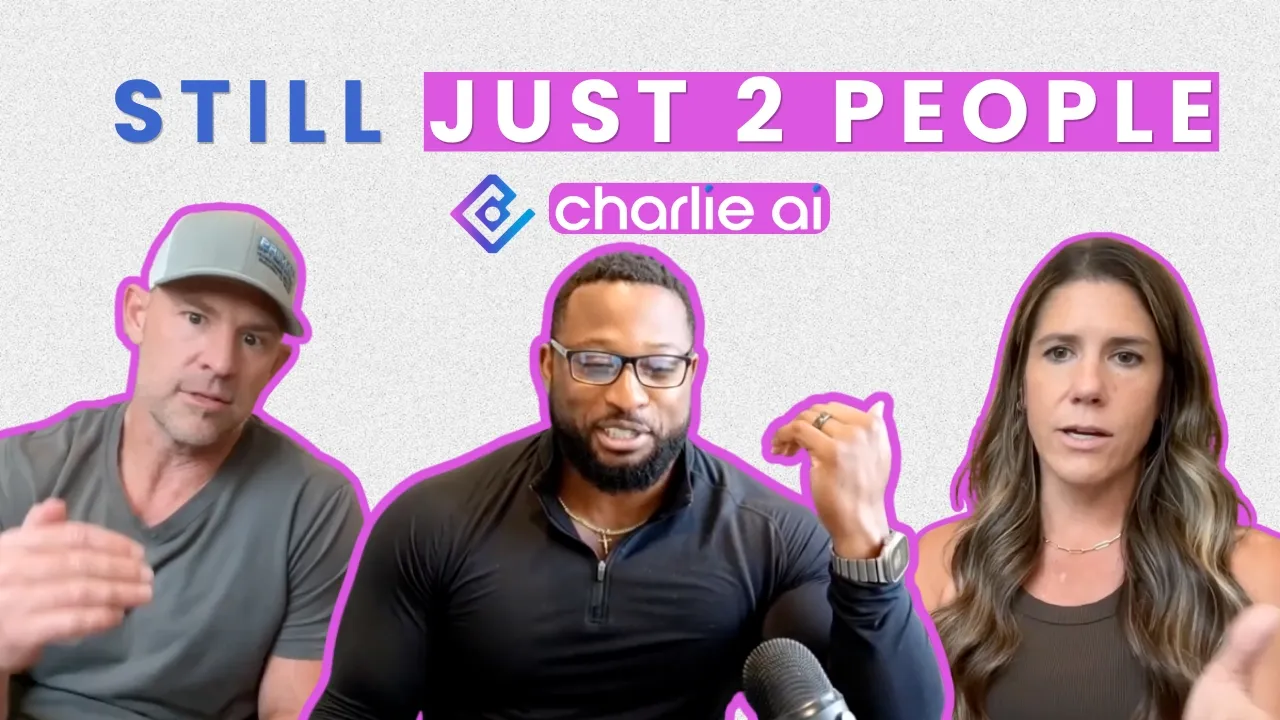
When I first met Tony and Arin Lindauer at a conference in Nashville, Arin was sitting in the same room as me, but part of her attention was somewhere else entirely.
She was working her DMs.
They had ads running, leads coming in, and conversations that needed to happen if those leads were ever going to turn into revenue. They had tried using a setter before, but managing that person had started to feel like another job. So Arin was back in the inbox, keeping everything moving while also trying to participate in the event.
That image stuck with me because it captures a stage of entrepreneurship that a lot of people misunderstand.
Tony and Arin did not have a demand problem.
They had created enough demand that keeping up with it had become the problem.
When they started working with CharlieAI, they were doing around $20,000 per month. Today, they say the business operates in the $40,000 to $60,000 per month range with Tony and Arin still at the center of an extremely lean operation.
The obvious headline is that they doubled the business.
But after sitting down with them for Founders Fires, I think the more interesting story is what they did not have to double to get there.
They did not double the size of the team.
They did not build a massive setter organization.
And they did not accept that more revenue had to mean more hours buried in DMs.
They built a business that could absorb more opportunity without requiring the same increase in human effort.
That is where CharlieAI became valuable.
There is a version of entrepreneurship where every problem gets solved with more.
Need more revenue? Get more leads.
Too many leads? Hire more setters.
More setters? Add management.
More customers? Add more people to fulfillment.
You can absolutely build a company that way. I have.
I have also seen what happens when every new layer of revenue brings another layer of operational weight with it.
Tony and Arin were beginning to run into their own version of that.
When Charlie first started helping manage conversations from their DM campaigns, bookings increased and that was a win but it exposed the next constraint.
Arin's calendar filled up. At one point, she had around 27 calls booked on her personal schedule.
They solved one capacity problem and immediately found another.
That is much closer to how scaling works in the real world.
You rarely “solve the business.”
You solve the constraint holding you back, grow into the next one, and then figure that one out.
For Tony and Arin, that meant moving away from a DM-heavy acquisition model and toward a VSL and application process they found more predictable. Charlie remained part of the sales engine, but its role evolved with the business.
Instead of Arin manually carrying every conversation forward, Charlie could keep working with leads after they entered the funnel, move them toward the calendar, and step in when something did not go according to plan.
That last part turned out to be more valuable than it sounds.
One of my favorite parts of our conversation was hearing Arin talk about no-shows.
She was honest: if somebody missed a sales call, she was not naturally going to chase them down.
I understand that completely.
When you have another call waiting, clients to serve, a family, and a company to run, it is easy to look at a no-show and think, “Cool, next.”
But the person who missed the call might still be a perfectly good prospect.
Their daughter might be sick. Something might have happened at work. Their day might have simply gone sideways.
None of that means they stopped needing what you sell.
But if nobody follows up, the reason does not matter. The opportunity is still gone.
Tony and Arin now use Charlie to close those gaps. When somebody cancels or no-shows, Charlie continues the conversation and works to get that person back onto the calendar.
Arin has watched people rebook through that process and later close—people she admits she probably would not have followed up with herself.
This is where the AI conversation gets much more practical.
Everybody wants to talk about using AI to generate more.
More leads. More outreach. More conversations.
But sometimes the better question is:
How much of what you already generated are you wasting?
You paid to acquire the lead.
You earned their attention.
They showed enough intent to book a conversation.
Losing that opportunity because nobody had the bandwidth or patience to follow up is an expensive leak.
Charlie does not get annoyed that somebody missed the meeting. It does not decide after the fifth follow-up that the prospect is wasting its time. It does not have another call to take or a bad day that changes the quality of its response.
It keeps doing the job.
For repetitive work that requires patience and consistency, that matters.
At one point during our conversation, I asked Tony and Arin how big their team was.
Their answer was basically: you're looking at it.
That is what caught my attention.
They came into CharlieAI doing around $20,000 per month. Today, they say the business is doing roughly $40,000 to $60,000 per month while remaining extremely lean.
I care about this because I have lived the opposite version.
I have managed teams with dozens of setters. I have built businesses where growth meant more people, more management, more moving pieces, and eventually a ridiculous amount of effort just to keep the machine running.
That approach can produce revenue.
It does not automatically create a good business to own.
This is why I talk so much about revenue per head.
AI gives service businesses a chance to rethink the relationship between revenue and headcount. Instead of assuming that doubling volume requires doubling the people managing it, you can ask which parts of the workload actually require a human.
Tony and Arin still show up.
They still sell, coach, make decisions, understand their numbers, and operate the company. Charlie is not running the business for them.
But they no longer need a human manually carrying every repetitive conversation across the finish line.
That difference creates leverage.
And leverage is what allows a two-person business to operate like something much larger.
There is another part of Tony and Arin's story that matters, especially because AI software is marketed terribly right now.
People are being trained to expect magic.
Connect the tool. Flip a switch. Go to sleep. Wake up rich.
That is not what happened here.
Tony and Arin had to work with CharlieAI.
They reviewed conversations, monitored performance, adjusted the messaging, and continued improving the system.
Arin mentioned that changing a single line in their messaging affected booking performance.
That is the part that gets me excited.
When I managed a team of around 40 setters, I wanted granular data on how each part of our scripts performed.
Good luck getting 40 people to accurately document the response rate of every message while also having conversations, updating the CRM, following up, and handling everything else a sales team has to do.
With Charlie, we can see where a conversation is working and where performance starts falling off a cliff.
Then we are not optimizing because somebody said a certain script is “best practice.”
We are optimizing based on what your leads are actually doing.
Tony and Arin were willing to go through that process. They did not treat the first imperfect conversation as proof that AI did not work. They trained it, adjusted it, and evolved it alongside the business.
That is an important lesson for any founder implementing AI.
You would never hire a salesperson on Monday, give them almost no context, and expect them to understand your brand, market, customers, objections, and sales process perfectly by Tuesday.
We should not suddenly apply that standard because the new team member happens to be software.
Toward the end of the conversation, I asked Tony and Arin about the biggest result they had gotten from CharlieAI.
Remember, this is a business that went from around $20,000 per month to operating in the $40,000 to $60,000 range.
Arin could have pointed to the revenue.
Instead, she talked about buying back her time.
That tells you a lot.
When we met, she was sitting at a conference working DMs because if she did not do it, those conversations would not have happened.
She told me she would have burned out if the business had continued operating that way.
Now she can start the week with calls already on her calendar. If somebody does not show, she does not have to personally hunt them down. Charlie keeps working the opportunity while she moves on to the work that actually requires Arin.
That is a completely different relationship with the business.
And it is probably the part of their story I relate to most.
I have built companies where the revenue looked great from the outside while the operational reality felt terrible from the inside.
After exiting some of those businesses, I was burned out enough to question whether I wanted to keep being an entrepreneur.
So when I started building again, I knew I did not want to recreate the same machine with newer technology slapped on top.
I wanted technology to help us build a fundamentally different kind of machine.
There is a line I kept coming back to after my conversation with Tony and Arin:
Build a business that actually serves you.
Founders sometimes lose sight of that.
We obsess over the next revenue milestone, hire, funnel, and channel. Then one day, we realize we have built ourselves an incredibly sophisticated job we can never leave.
Tony and Arin are not finished building. They are already thinking about where the company goes next and who they may eventually bring into fulfillment as they create more capacity.
But now they can make those decisions from a very different position.
They are not hiring because the inbox is on fire.
They are not adding people because someone needs to chase a missed appointment.
They can add human talent where human talent actually makes the business better.
That, to me, is one of the most compelling promises of AI for entrepreneurs.
Not: “How many people can I replace?”
Not: “How much can I automate?”
The better question is:
How much unnecessary weight can I remove from the way this business grows?
Tony and Arin doubled their business. That is impressive.
But they also built more predictability, recovered opportunities that used to fall through the cracks, removed repetitive work from their own shoulders, and bought back some of the time growth was beginning to take away.
That is the business story I am interested in.
Experience It
Share your number and Charlie will text you to start a conversation. You can ask questions, explore features, or even request a call directly with the AI.